

This article was published in https://icepe.eu/news/ Oct 2025
In honour of Dyslexia Awareness Month, Occupational Therapist and Therapix founder Banu Balaji shares a powerful insight:
“Reading doesn’t begin with letters—it begins with the body.”
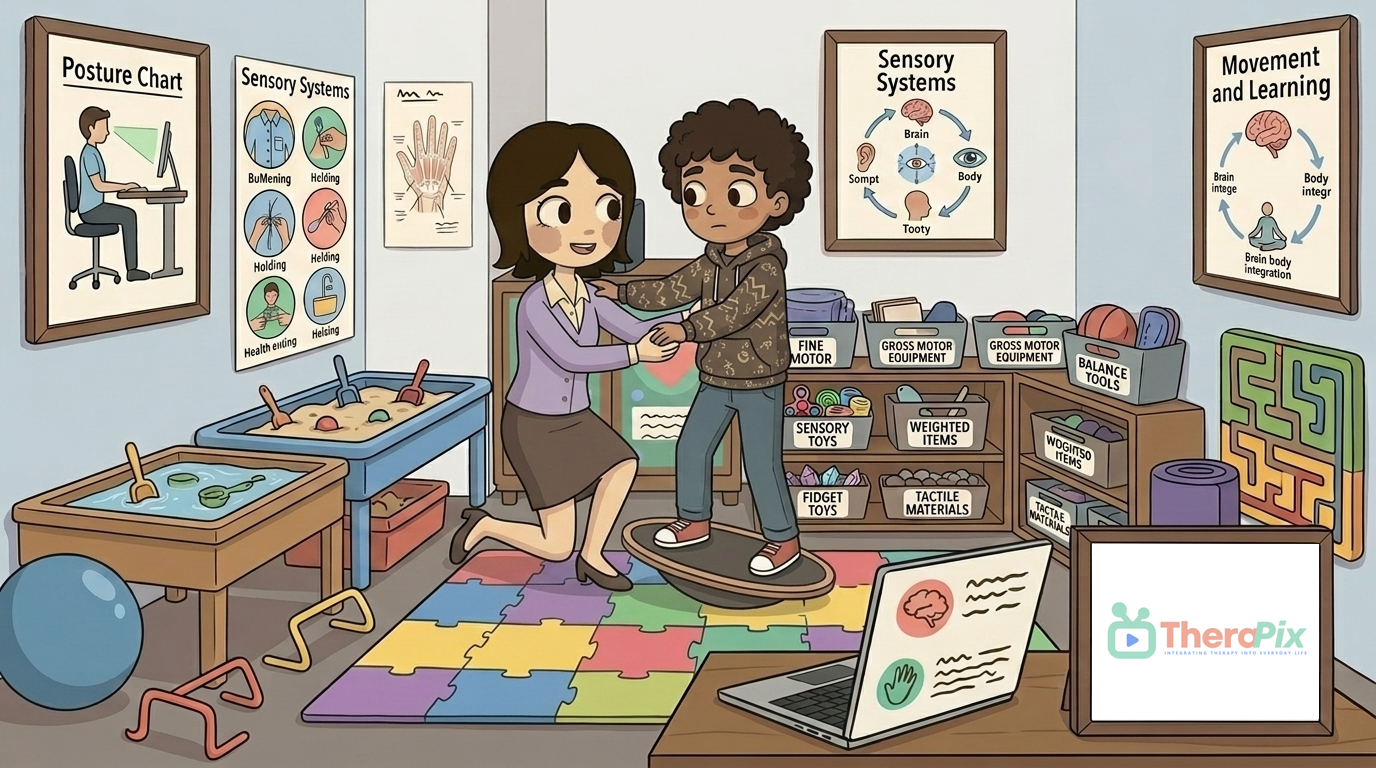
While dyslexia is often seen as a reading issue, research shows that many learners also experience challenges with sensory and motor development—the foundation upon which literacy is built.
Think of learning as a pyramid:
Top of Pyramid: Reading, Spelling, Writing, Focus
Middle Layer: Attention, Eye Tracking, Posture, Fine Motor Skills
Foundation: Sensory and Motor Systems – Balance (Vestibular), Body Awareness (Proprioception), Touch (Tactile), Coordination
When the foundation is weak, tasks like sitting still, following words on a page, gripping a pencil, or concentrating become overwhelming.
What the Research Shows
- Wandel & Le (2017) found that effective reading relies on successful sensory integration—how the brain processes movement, touch, and visual input together.
- Barela et al. (2025) reported that combining movement-based therapy with language-focused interventions improves reading fluency, eye movements, and learning outcomes in children with dyslexia.
Movement is not a distraction from learning—it’s a pathway to it.
Practical Strategies for Parents & Teachers
✅ 1. Bring Movement Into the Day
Instead of long hours at desks:
- Encourage dance, sports, yoga, or playground time.
- Try games that involve crossing the midline or using both sides of the body together.
✅ 2. Make Movement Meaningful
Give children roles that involve activity—watering plants, setting tables, carrying books, cleaning whiteboards.
Purposeful tasks build physical skills and self-esteem.
✅ 3. Use Sensory Tools for Regulation
Simple, low-cost supports can make learning easier:
- Fidget tools
- Chewing gum or oral sensory tools
- Weighted lap pads or blankets
- Stretchy bands on chair legs
- Short “brain breaks” every 20–30 minutes